
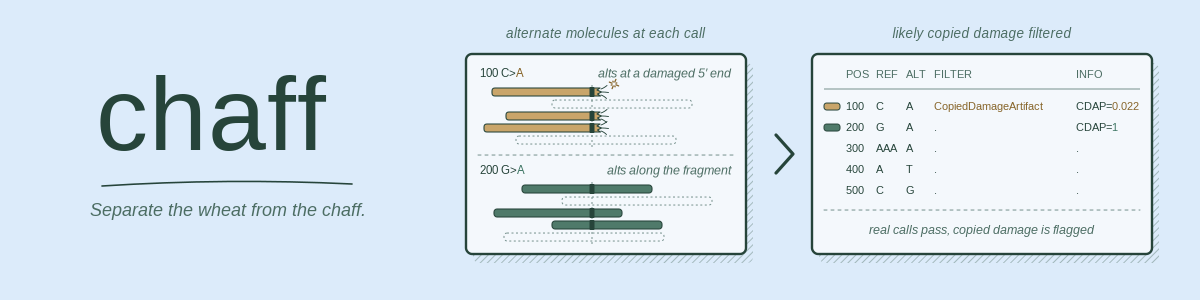



Flag somatic variant calls that are library-preparation artifacts.
Install with mamba, conda, or run directly with pixi:
pixi exec \
    -c conda-forge -c bioconda \
chaff --helpThe chaff tool needs a VCF of somatic calls, the BAM they were called from, and a reference FASTA with a .fai index.
The examples below run from a clone of this repository on the test data from fgbio's FilterSomaticVcf [6], which are plain read pairs, not a duplex consensus BAM.
Copied damage is a damaged base that a polymerase copied onto the partner strand before the UMI adapters were ligated, so both strands carry the change. To score calls for copied damage and filter the likely artifacts:
chaff \
    --input tests/data/calls.vcf \
    --bam tests/data/tumor.bam \
    --ref tests/data/ref.fa \
    --sample tumor \
    --filters copied-damage \
    --copied-damage-threshold 0.05 \
    --metrics tumor.chaff.tsv \
    --output calls.chaff.vcf.gz
The annotated calls are written to calls.chaff.vcf.gz, with likely copied damage filtered, and the per-sample metrics to tumor.chaff.tsv:
gzip -dc calls.chaff.vcf.gz | grep -v '^#' | cut -f 2,4,5,7,8 | column -t100 C A CopiedDamageArtifact CDAP=0.022;CDLR=1.577;CDAC=3,3;CDRC=72,240
200 G A . CDAP=1;CDLR=-4.55;CDAC=6,20;CDRC=72,240
300 AAA A . .
400 A T . .
500 C G . .
The CDAP field is the posterior probability that a call is a real mutation and not copied damage.
It depends on where the call's molecules fall on their fragments and on how common the artifact is in the sample.
A low value means likely copied damage.
A molecule is one DNA fragment, counted once no matter how many reads cover it.
Copied damage treats the C>A call at position 100 as an oxidized G on the reverse strand.
All 3 of its alternate molecules are within 23 bp of that strand's 5′ end (CDAC=3,3), compared with 72 of its 240 reference molecules (CDRC=72,240).
Its CDAP of 0.022 is below the 0.05 threshold, so it is filtered.
What each filter can detect depends on the BAM, because a consensus removes artifacts carried by only one strand:
| Data | Run | What each detects |
|---|---|---|
| Reads | All three | Copied damage: lesions in its damage classes near the lesion strand's 5′ end, whether or not they were copied to the partner strand. End repair fill-in: bases misincorporated while a polymerase filled in a recessed 3′ end. A-tailing: a non-templated A at the last base of a 3′ end. |
| Simplex consensus | All three | Same as reads. A simplex consensus collapses the reads of one strand, so single-strand artifacts survive it. |
| Duplex consensus | Copied damage, and end repair fill-in as a fragment-end filter | Copied damage: lesions copied onto both strands before adapter ligation, which a duplex consensus keeps. This is the main filter for Duplex Sequencing. End repair fill-in: any substitution that both strands agree on and that clusters near either fragment end. A-tailing: nothing, unless trimming left the A-tail in place (see the note under A-Tailing). |
A CODEC consensus [9] from fgbio's CallCodecConsensusReads or fgumi codec [10] has one unpaired record per molecule with duplex tags.
It is treated as a duplex consensus whose template ends are the record's outermost bases.
Each of its strands comes from a single raw read, below the minimum of 2 needed for the single-strand rate, so the prior is learned from the calls, as for a BAM without single-strand tags.
By default every filter runs and only annotates calls. A filter applies its FILTER only once it has a threshold (see Setting Thresholds).
Some workflows call many samples into one multi-sample VCF from a single BAM that holds every sample's molecules.
Artifacts come from the library, not the sample, and one sample may have only one or two molecules at a site, which is too few to score.
With --pooled, each SNV is scored once against every molecule in the BAM, as one sample.
In a pooled run each SNV is scored as heterozygous for REF and its first alternate allele, regardless of genotype.
Sample columns are written back unchanged, and INFO annotations and FILTERs are added as usual.
The metrics and spectrum label the sample pooled.
A VCF without samples, such as a sites-only VCF, is always scored this way.
The --pooled option cannot be combined with --sample.
This example scores the two samples of the test VCF as one pool, keeping the normal column's 0/0 and the tumor column's 0/1:
chaff \
    --input tests/data/calls.vcf \
    --bam tests/data/tumor.bam \
    --ref tests/data/ref.fa \
    --pooled \
    --copied-damage-threshold 0.05 \
    --metrics pooled.chaff.tsv \
    --output calls.pooled.vcf.gz
gzip -dc calls.pooled.vcf.gz | grep -v '^#' | cut -f 2,4,5,7,10,11 | column -t
100 C A CopiedDamageArtifact 0/1 0/0
200 G A . 0/1 0/0
300 AAA A . 0/1 0/0
400 A T . 0/1 0/0
500 C G . 0/1 0/0
A template is one DNA fragment, represented by its two mates (reads or consensus reads), and counts as one molecule. Its template ends are its outermost bases, the 5′ ends of its two strands. A lesion is a damaged base on one strand that a polymerase copies as a different base:
- 5-methylcytosine deaminates to thymine, so a methylated CpG reads as C>T.
- Cytosine deaminates to uracil, so any C can read as C>T. Pfu-family proofreading polymerases stall at template uracil and often leave it uncopied, so after PCR with one of them most surviving deamination is 5-methylcytosine at CpG. The copied damage filter learns separate rates for CpG and other contexts.
- Guanine oxidizes to 8-oxoguanine, which pairs with A, so a G reads as G>T, or C>A on the other strand.
Duplex Sequencing [2] ligates UMI adapters to both ends of each fragment, builds a single-strand consensus for each strand, and calls each duplex consensus base from the two.
When the strands agree, the base gets their summed quality.
When they disagree, fgbio's CallDuplexConsensusReads and fgumi duplex keep the higher-quality strand's base with the difference of the two qualities, or an N on a tie [7].
The consensus filters, fgbio's FilterConsensusReads and fgumi filter, mask every base the strands disagree on only with --require-single-strand-agreement, which is off by default [8].
Without it, only the minimum base quality masks such a base, so it survives whenever one strand's quality exceeds the other's by at least that minimum, as when a strand of many reads disagrees with a strand of one read.
Turn the option on when building a BAM for chaff.
With it off, a change on only one strand can survive as an alternate molecule whose quality is the gap between the strands.
The tool drops these below --min-base-quality (default 20) and counts the rest as ordinary alternate molecules.
An uncopied lesion near its strand's 5′ end then looks like copied damage and is counted as such in CDAC, the metrics, and the spectrum.
With it on, a duplex consensus removes every single-strand error, including uncopied lesions, but not damage copied onto both strands before adapter ligation. That copying happens during end repair. The polymerase extends each recessed 3′ end across the opposite 5′ overhang, and from nicks where it displaces strands, copying any lesion it passes onto the new strand. The change then appears on both strands, like a real mutation.
Each filter compares where a call's alternate molecules are on their templates with where its reference molecules are.
It then writes the posterior probability that the call is real, given the sample's artifact fraction: the share of the sample's calls that are artifacts, learned from all of them.
Under --model fgbio, which exists to reproduce fgbio's values, each call's artifact fraction comes from its own alternate allele fraction instead.
A low posterior means a likely artifact, and a threshold filters calls at or below it.
Each filter models one library-preparation step that leaves an artifact near a known end of the fragment:

Fill-in length varies between fragments, so the evidence for copied damage and end repair fill-in falls off with distance from the end. Both filters model this as an exponential decay whose scale, the mean fill-in length, is learned per sample. A-tailing changes only the last base of a 3′ end and is scored within a 2 bp window.
The filters score SNVs with a heterozygous or missing genotype (many somatic callers leave it missing), and every SNV in a pooled run. Indels pass unscored, as do homozygous and haploid calls outside a pooled run, because the filters compare alternate molecules with the sample's reference molecules at the site. Copied damage scores SNVs in its damage classes on either strand: C>T covers C>T and G>A calls, and G>T covers G>T and C>A calls. A-tailing scores SNVs whose alternate base is A or T, and end repair fill-in scores all SNVs.
If the sample does not carry REF, for example at a site homozygous for another germline allele, each filter scores the call from the base the sample does carry.
A G>T call in a sample homozygous for C is scored as a C>T.
If the sample carries REF and another base, the call is scored from both, each weighted by its molecules and its artifact rate.
A base other than REF or a called alternate counts as carried when it is on at least 10 molecules and on more than 2% of the molecules without a called alternate.
REF on 2 or fewer molecules is treated as a stray.
The PA INFO field lists the bases a call was scored from.

Copied damage puts the change on both strands, so a duplex consensus keeps it. A library prep can prevent it by fragmenting with a restriction enzyme that leaves blunt ends, as NanoSeq does [3], or by repairing lesions before end repair, as Duplex-Repair does [4].
- Measured from: the 5′ end of the lesion strand, the strand that carries the damaged base.
- Scored with: a decay with a scale learned per sample, starting from 30 bp.
- Writes: the posterior
CDAP, the likelihood ratioCDLR, the molecule countsCDACandCDRC, and the FILTERCopiedDamageArtifact. - Use it when: UMI adapters are ligated after a polymerase fills in ends, nicks, or gaps, as in Duplex Sequencing. Requires
--ref.
Fill-in runs from the partner's recessed 3′ end toward the lesion strand's 5′ end, so copied lesions cluster near that end. A real mutation's molecules are spread the same way as the reference molecules. On reads or a simplex consensus, uncopied lesions are visible too. Deamination among them is concentrated at the same 5′ ends, where the overhangs were single-stranded [1], so the filter flags those as well.
Lesions copied from an internal nick, by nick translation or strand displacement, or across the gap left by an abasic site, can be anywhere in the template. Their position carries no end signal, so they show up only as an excess of the damage class across the library.
A duplex consensus BAM with each strand's single-strand consensus, in the ac, bc, ad, and bd tags that fgbio and fgumi write, addresses this.
With those tags the tool makes a second pass over every molecule, counting duplex changes and single-strand changes (uncopied lesions on one strand) per damage class and context.
A molecule counts toward the single-strand rate only if at least 2 raw reads agree with each strand's base.
Agreeing reads are the ad or bd depth minus the ae or be errors, or the depth alone if the error tags are missing.
Copied lesions hit a position one molecule at a time, while a clonal mutation puts several molecules at one position.
So for a call with two or more alternate molecules, the prior artifact fraction becomes the share of library positions of the same depth, with as many changes, that chance alone explains.
The learned fraction is used instead with --copied-damage-prior learned, or when the call looks germline (alternate in at least 20% of its molecules).
The chance prior has two weaknesses. Two independent real mutations at one position also look like chance, so when real single-molecule mutations occur at a tenth of the damage rate or more, the chance prior filters some real calls with two molecules. A position damaged far more than the rest of its class appears real under the chance prior, so a threshold there depends on the decay alone. Without the single-strand tags, the artifact fraction is learned from the calls.

On reads or a simplex consensus, this filter flags bases a polymerase misincorporated while filling in a recessed 3′ end. These errors are on the extended strand, near its 3′ end. A lesion copied from the overhang is there too, and that is copied damage, so a call near an end can be flagged by both filters, like the call at position 100 in 3. Set and Check.
A duplex consensus has already removed misincorporations, since each is on one strand. There the filter flags any substitution both strands agree on that clusters near either fragment end. That includes copied damage of any chemistry and anything else concentrated at fragment ends, but not fill-in errors.
- Measured from: the 3′ end of the read 1 strand, which end repair extended. That is the higher-coordinate end of an F1R2 pair, whose read 1 is forward, and the lower-coordinate end of an F2R1 pair. On a duplex consensus, recognized by fgbio's
aDandbDper-strand depth tags, it is the nearer template end, since the change can be at either strand's end. - Scored with: a decay with a scale learned per sample, starting from 15 bp, or 5 bp on a duplex consensus, where the changes are within a few bases of the end.
- Writes: the posterior
ERFAPand the FILTEREndRepairFillInArtifact. - Use it when: a polymerase end-repaired the library before adapter ligation, as in most ligation preps after mechanical or enzymatic fragmentation. On a duplex consensus, use it when calls cluster at fragment ends.
Copied damage and end repair fill-in both look at the bases end repair filled in, from opposite strands:
| Copied Damage | End Repair Fill-In | |
|---|---|---|
| Source of the wrong base | A damaged template base that the polymerase copies | A base the polymerase misincorporates during fill-in |
| Strand at fault | The lesion strand; the copy is on its partner | The extended strand |
| Strands that carry it | Both, once copied | One |
| Duplex consensus | Keeps it | Removes it |
| Classes scored | C>T and G>T, on either strand | Any substitution |
| Measured from | The lesion strand's 5′ end | The extended strand's 3′ end, or the nearer end of a duplex consensus |
| Decay scale | Learned, from 30 bp | Learned, from 15 bp, or 5 bp on a duplex consensus |
On a duplex consensus, use this filter instead of a variant caller's filter on the mean distance from a call to the nearest read end.
Once overlapping mates are clipped, each clip point in the middle of a fragment is also a read end, so a read-end filter also flags real calls whose few alternate molecules happen to be near one.
The file tests/data/duplex.bam holds the example reads as a duplex consensus with those depth tags:
chaff \
    --input tests/data/calls.vcf \
    --bam tests/data/duplex.bam \
    --sample tumor \
    --filters end-repair-fill-in \
    --end-repair-fill-in-threshold 0.05 \
    --output calls.duplex.vcf.gz
gzip -dc calls.duplex.vcf.gz | grep -v '^#' | cut -f 2,4,5,7,8 | column -t
100 C A EndRepairFillInArtifact ERFAP=0.001182
200 G A . ERFAP=1
300 AAA A . .
400 A T EndRepairFillInArtifact ERFAP=0.00002302
500 C G EndRepairFillInArtifact ERFAP=0.00002302
The learned scale is 3.75 bp, and every call whose alternate molecules are within 3 bases of a template end is filtered. That includes the A>T at position 400 and the C>G at position 500. Their molecules are at the 5′ end of the read 1 strand, where end repair adds no bases, so they pass on the read pairs in 3. Set and Check.

A-tailing adds a non-templated A to each 3′ end so that adapters with a T overhang can be ligated. If end repair over-digested a 3′ end by one base, the A replaces the lost base on that strand only, so a duplex consensus usually removes it. On the forward strand it reads as an A near the template's higher-coordinate end, and on the reverse strand as a T near the lower-coordinate end.
- Measured from: the template end where the added A appears, the lower-coordinate end for a T and the higher-coordinate end for an A.
- Scored with: a 2 bp window, as in fgbio.
- Writes: the posterior
ATAPand the FILTERATailingArtifact. - Use it when: the library was A-tailed for T-overhang adapters, unlike blunt-end ligation or transposase (tagmentation) preps, and the BAM is not a duplex consensus.
Note
If read trimming leaves the A-tail in place, the non-templated A can appear on both strands and survive a duplex consensus, at the last base of a 3′ end.
Before dropping A-tailing for a Duplex Sequencing library, measure it as in 2. Measure. A small asymmetry_p_value in its metrics rows means the library has the artifact.
Every filter runs by default but only annotates calls until it has a threshold, so choosing a filter means setting its threshold. Start from each filter's Use it when line, then check the data. Set a threshold when somatic calls show an excess of C>T or C>A with few supporting molecules, when their alternate bases cluster at one fragment end, or when the filter's metrics show a small asymmetry p-value. Expect copied damage in old, stored, or degraded specimens, and when C>T at CpG exceeds what the matched normal or the clock-like signature SBS1 predicts.
Profile the raw reads before consensus with the error tool of Riker:
riker error -i raw.bam -r ref.fa -o raw --stratify-by ref_base,read_base,read_num,cycleThe output raw.error-mismatch.txt gives each substitution's frac_error by read number and cycle, in sequencing orientation.
For example, the row C,T,R1,1 is read 1's C>T rate at cycle 1.
A C>T rate that rises toward cycle 1 is deamination in single-stranded 5′ overhangs [1], the lesions end repair copies.
A C>A excess on one read number but not the other is 8-oxoguanine, the read-orientation bias that GATK's LearnReadOrientationModel [5] models.
An A or T excess at read ends is A-tailing.
How far an excess extends from read starts is a rough check on the decay scales the tool learns.
Damage copied onto both strands before adapter ligation looks the same on both strands, so no strand or read-number metric can separate it from a real variant. Only the next step can detect it.
Run the filters without thresholds so they only annotate, and write the metrics and spectrum. Each stratum's artifact fraction is learned from every scored call regardless of its FILTER, so first remove the calls your caller rejected:
chaff \
    --input tests/data/calls.vcf \
    --bam tests/data/tumor.bam \
    --ref tests/data/ref.fa \
    --sample tumor \
    --output calls.annotated.vcf.gz \
    --metrics tumor.chaff.tsv \
    --spectrum tumor.spectrum.pdf
In the spectrum, compare the expected real SNVs with all SNVs. Copied damage shows up as C>T at CpG, or C>A, that shrinks after weighting while the other channels keep their height.
Each metrics row covers one filter and stratum, a group of calls that share an artifact rate. For copied damage a stratum is a damage class and CpG context, and for the other filters it is a substitution. Every stratum a filter can score gets a row, with zero counts if it has no calls, so tables from different samples line up. The columns are:
- Calls: the
callsscored and the callsfiltered. - Fractions: the
artifact_fractionis the stratum's learned share of artifacts. It stays near the filter-widefilter_artifact_fractionuntil the stratum has many calls. Both are empty under--model fgbio, whose prior is per call, and when no call has a posterior to learn from. Theexpected_artifactsandexpected_mutationscolumns sum each call's probability of being an artifact or a real mutation, and a call without a posterior counts as real. - Distance: the
distanceis the decay scale or window in bases, shared by all of a filter's strata. It is empty when the scale is learned and the filter has no call to learn it from. - Molecules: the
alt_moleculesandref_moleculesmeasured, and their_congruentcounts and fractions, the molecules withindistanceof the artifact's end. - Asymmetry: the
expected_alt_congruentcount is the alternate molecules expected withindistancefrom each call's reference molecules, andasymmetry_p_valueis a one-sided test for more than that. A small value means the library has the artifact. - Single strand: for copied damage on a BAM with single-strand consensus,
change_rateandsingle_strand_rateare the duplex and single-strand changes of the class per molecule, over positions with more than 10 molecules, whether or not a call falls in the stratum. Theconversion_ratiois the first over the second, andchance_fractionis the mean prior of the stratum's calls. Thechance_excessis the number of positions with two or more changes that chance predicts beyond those observed and their noise, as a share of those observed, and is zero when the model fits.
To show only the strata with a call:
awk -F'\t' 'NR == 1 || $4 > 0' tumor.chaff.tsv | cut -f 2,3,6,8,18 | column -tfilter stratum artifact_fraction distance asymmetry_p_value
copied-damage C>T:non-CpG 0.44854 23.0591 0.589947
copied-damage G>T:CpG 0.537421 23.0591 0.0274487
a-tailing C>A 0.19272 2.0 0.00246167
a-tailing C>T 0.189318 2.0 1.0
a-tailing T>A 0.189332 2.0 0.000231639
end-repair-fill-in C>A 0.391688 12.1865 0.00451579
end-repair-fill-in C>G 0.301492 12.1865 1.0
end-repair-fill-in C>T 0.301492 12.1865 0.665409
end-repair-fill-in T>A 0.301492 12.1865 1.0
Each stratum has one call and each filter learns from only 2 to 4 calls, so the fractions stay near the filter-wide value and say little here. The p-values are more informative: they are small for copied damage's G>T:CpG, A-tailing's C>A and T>A, and end repair fill-in's C>A. The learned scales, 23.1 bp from 2 copied damage calls and 12.2 bp from 4 end repair calls, fall between the defaults of 30 and 15 bp and the 3 bp within which the call at position 100 has all its alternate molecules. The counts behind each p-value are in its row:
grep -e ^sample -e a-tailing tumor.chaff.tsv | cut -f 3,11,12,13,18 | column -tstratum alt_molecules alt_congruent expected_alt_congruent asymmetry_p_value
C>A 3 2 0.0867769 0.00246167
C>T 20 0 0.578512 1.0
T>A 5 3 0.144628 0.000231639
For the A>T at position 400, 3 of 5 alternate molecules are where A-tailing would put them, against 0.14 expected, but the other 2 cannot be A-tailing, so the call passes. The p-value measures whether the library has the artifact, while the posterior estimates whether one call is an artifact.
A threshold of 0.05 filters the calls with at most a 5% chance of being real.
This run sets all three thresholds to 0.05, which suits these plain read pairs, and the .vcf.gz extension makes the output BGZF-compressed:
chaff \
    --input tests/data/calls.vcf \
    --bam tests/data/tumor.bam \
    --ref tests/data/ref.fa \
    --sample tumor \
    --output calls.chaff.vcf.gz \
    --copied-damage-threshold 0.05 \
    --end-repair-fill-in-threshold 0.05 \
    --a-tailing-threshold 0.05
gzip -dc calls.chaff.vcf.gz | grep -v '^#' | cut -f 2,4,5,7 | column -t
100 C A CopiedDamageArtifact;EndRepairFillInArtifact
200 G A .
300 AAA A .
400 A T .
500 C G .
The call at position 100 is filtered as both copied damage and end repair fill-in, and the deletion at position 300 is not scored. The calls at positions 400 and 500 pass. Their alternate molecules are at the 5′ end of the read 1 strand, where end repair adds no bases, and 2 of the A>T's 5 alternate molecules are where A-tailing cannot put them.
To estimate how many real calls a threshold removes, add a few germline heterozygous SNVs from the same sample in the stratum it filters, such as C>T at CpG for copied damage.
Downsample them to the alternate molecule counts of your somatic calls, and add few enough that the stratum's artifact_fraction barely changes.
Compare the metrics with and without them, and count how many the threshold filters.
If a matched normal or a replicate library exists, the somatic calls shared with it are a second check.
A threshold makes a yes or no decision for each call, and at 2 alternate molecules it catches only a minority of copied damage.
For a mutation burden or frequency, weight each call by its CDAP instead, as the expected_mutations metrics column does.
Summing that column over the copied damage strata of the run above gives the expected number of real calls:
awk -F'\t' '$2 == "copied-damage" { print $3, $10; n += $10 } END { print "total", n }' \
    tumor.chaff.tsv | column -t
C>T:CpG 0.0
C>T:non-CpG 0.999977
G>T:CpG 0.0222778
G>T:non-CpG 0.0
total 1.02225
Of the 2 copied damage calls, the G>A at position 200 counts as real and the C>A at position 100 almost certainly does not.
The figures below come from a simulated duplex sample, generated and scored by tests/figures.py, with:
- 6,000 real mutations across all channels, and 2,000 copied damage calls at CpG C>T;
- a quarter of each with 2, 3, 5, or 10 alternate molecules, among about 400 duplex molecules per site, on fragments of median length 200 bp;
- fill-in that copies 80% of lesions from the lesion strand's 5′ end over an exponentially distributed length with a mean of 30 bp, and the other 20% from nicks anywhere in the template.
The tool learns a scale of 42.0 bp, longer than the 30 bp mean because the lesions copied from nicks can be anywhere. Within that scale are 66% of the copied damage's alternate molecules, compared with 23% of the real mutations' and of the reference molecules:

A threshold of 0.05 filters 821 of the 2,000 copied damage calls, 9 of the 1,065 real C>T at CpG, and none of the 4,935 calls in other channels.
It filters 73% of the copied damage with 10 alternate molecules, 50% with 5, 34% with 3, and 6% with 2.
In the figure, each curve sweeps the threshold and plots the share of copied damage filtered against the share of real C>T at CpG filtered, with filled dots at 0.05.
Open circles show --model fgbio, which at 0.05 filters 1,955 of the copied damage calls but also 94%, 75%, 49%, and 11% of the real C>T at CpG with 2, 3, 5, and 10 alternate molecules.
Under --model chaff, that share is at most 1.6%:

In simulated libraries of 400 C>T calls at CpG, most with 2 to 4 alternate molecules and 60% of them copied damage, counting every call overstates the real count 2.5-fold.
A threshold of 0.05 reduces that to 2.2-fold, and weighting by CDAP to 1.2-fold:

Weighting cannot fully correct the overcount when calls have 2 molecules and few of them are near an end.
There the learned artifact fraction underestimates damage, 51% for a true 60% here, and real data may be worse.
Under --model chaff, calls are real somewhat less often than their CDAP predicts, and under --model fgbio far more often.
The learned artifact fraction and the asymmetry p-value still rank samples by damage, so they are useful per-sample covariates:

Each filter writes INFO fields to the calls it scores, and its FILTER to the calls at or below its threshold:
| Name | Stands for | Meaning |
|---|---|---|
CDAP |
Copied Damage Artifact Posterior | The posterior probability that the call is a real mutation and not damage copied onto both strands. A low value means likely copied damage. |
CDLR |
Copied Damage Likelihood Ratio | The log10 likelihood ratio of copied damage to a real mutation. A high value favors copied damage. |
CDAC |
Copied Damage Alternate Counts | The alternate molecules within the decay scale of the lesion strand's 5′ end, and all alternate molecules measured. |
CDRC |
Copied Damage Reference Counts | The same two counts for the reference molecules. |
ERFAP |
End Repair Fill-in Artifact Posterior | The posterior probability that the call is a real mutation and not an end repair fill-in error. A low value means a likely error. |
ATAP |
A-Tailing Artifact Posterior | The posterior probability that the call is a real mutation and not an A-tailing artifact. A low value means a likely artifact. |
PA |
Parent Alleles | The bases the call was scored from, written when one is not REF: that base alone, or REF then that base. |
CDPW |
Copied Damage Parent Weight | The weight in CDAP of the second base in PA, written when PA holds two. |
CopiedDamageArtifact |
A FILTER | Applied when CDAP is at or below the copied damage threshold. |
EndRepairFillInArtifact |
A FILTER | Applied when ERFAP is at or below the end repair fill-in threshold. |
ATailingArtifact |
A FILTER | Applied when ATAP is at or below the A-tailing threshold. |
The tool learns how common each artifact is and how far it reaches per sample, so most runs need only the filters and their thresholds.
The model behind the posteriors is documented in src/lib/mod.rs.
| Option | Sets |
|---|---|
--input |
The coordinate-sorted VCF or BCF of somatic calls. It is read twice, so it must be a file, not standard input (short -i; required). |
--output |
The output VCF or BCF, its format set by its extension: .vcf, .vcf.gz, .bcf, or - for plain VCF on standard output. A .vcf.gz gets a tabix index at .vcf.gz.tbi, and a .bcf a CSI index at .bcf.csi (short -o; required). |
--bam |
The coordinate-sorted BAM of reads or consensus reads; no index is needed. Distances from template ends are counted through both mates' CIGARs, so each mate of a pair on one contig needs its mate's CIGAR in its MC tag. Insert size is never read (short -b; required). |
--ref |
The reference FASTA, with its .fai, for CpG context. The copied damage filter and --spectrum need it, and giving it without either is an error (short -r). |
--sample |
The sample the BAM holds, required when the VCF has more than one sample unless --pooled is given (short -s). |
--pooled |
Score every SNV against the whole BAM as one sample, labelled pooled, regardless of genotype, and write every sample column back unchanged. For many samples that share one library and one BAM. A VCF without samples is always scored this way. Cannot be combined with --sample (default off). |
--metrics |
The per-sample metrics TSV, one row per filter and stratum (default none). |
--spectrum |
A PDF of the sample's SNVs by trinucleotide context, before and after filtering, with all panels on one scale. The panels show every heterozygous SNV regardless of FILTER, in the channel of the base it was scored from; the expected real SNVs, each weighted by the product of its posteriors from the filters in --filters; and, when a filter has a threshold, the SNVs no filter flagged (default none). |
--min-mapping-quality |
The minimum mapping quality of a read or consensus read (short -m; default 20). |
--min-base-quality |
The minimum base quality at the call (short -q; default 20). |
--paired-reads-only |
Use only paired reads or consensus reads whose mate is also mapped. Duplicate, secondary, and supplementary records are always excluded (short -p; default off). |
--filters |
The filters to run, comma-separated, from copied-damage, end-repair-fill-in, and a-tailing (default copied-damage,a-tailing,end-repair-fill-in). |
--model |
The scoring model. With chaff, artifact fractions are learned per sample and stratum by EM, and end repair fill-in and copied damage use decays. With fgbio, calls get fgbio's per-call (2 * maf)^2 prior and windows, for parity (default chaff). |
--copied-damage-classes |
The damage classes as damaged base > read base, comma-separated, each matched on either strand. The class C>T is cytosine or 5-methylcytosine deamination and covers REF/ALT C/T and G/A; G>T is guanine oxidation to 8-oxoguanine (default C>T,G>T). |
--copied-damage-distance |
The decay scale in bases from the lesion strand's 5′ end: the mean length over which a polymerase copies a lesion strand onto its partner. It is learned per library under either model unless set to a number. Molecules within it count as congruent in the metrics (default learned). |
--copied-damage-prior |
The source of each call's copied damage prior under --model chaff. With chance, on a BAM with single-strand consensus, it is the share of library positions of the same depth with as many duplex changes that chance explains, and the learned fraction otherwise. With learned, it is the fraction learned per sample and stratum from the calls (default chance). |
--copied-damage-threshold |
Apply CopiedDamageArtifact at or below this posterior (default none). |
--end-repair-fill-in-distance |
The distance in bases from a template end, or learned. Under --model chaff, it is the decay scale from the 3′ end of the read 1 strand, or the nearer end of a duplex consensus, learned from 15 bp (5 bp on a duplex consensus) unless fixed. Under --model fgbio, it is fgbio's window from the nearest template end, 15 unless fixed. Molecules within it count as congruent in the metrics (default learned). |
--end-repair-fill-in-threshold |
Apply EndRepairFillInArtifact at or below this posterior (default none). |
--a-tailing-distance |
The window in bases from the template end, under either model (default 2). |
--a-tailing-threshold |
Apply ATailingArtifact at or below this posterior (default none). |
The VCF/BCF and the BAM must be coordinate sorted with their contigs in the same order, and neither needs an index.
The FASTA needs a .fai.
A compressed output is indexed as it is written, so it needs no separate bcftools index step.
Each template counts once.
Both template ends are measured for an FR pair, whose forward mate starts at or before its reverse mate's 5′ end, and for an unpaired duplex consensus, from its outermost bases.
For any other pair, only each mate's own end is measured.
These are usage errors: an option for a filter that --filters leaves out, --ref without copied-damage or --spectrum, and --copied-damage-prior or --end-repair-fill-in-distance learned given with --model fgbio.
A VCF that already declares an enabled filter's INFO or FILTER, such as from an earlier run, is rejected.
Remove them first, for example with bcftools annotate -x.
See the contributing guide for more information.
The end repair fill-in and A-tailing filters are ports of fgbio's FilterSomaticVcf [6], with its likelihoods, tests, INFO keys, and FILTER names, so --model fgbio reproduces its values.
The copied damage filter is new and builds on these papers and tools:
- Briggs AW, et al. 2007. Patterns of damage in genomic DNA sequences from a Neandertal. Proceedings of the National Academy of Sciences 104(37):14616–14621. https://doi.org/10.1073/pnas.0704665104
- Schmitt MW, et al. 2012. Detection of ultra-rare mutations by next-generation sequencing. Proceedings of the National Academy of Sciences 109(36):14508–14513. https://doi.org/10.1073/pnas.1208715109
- Abascal F, et al. 2021. Somatic mutation landscapes at single-molecule resolution. Nature 593(7859):405–410. https://doi.org/10.1038/s41586-021-03477-4
- Xiong K, et al. 2022. Duplex-Repair enables highly accurate sequencing, despite DNA damage. Nucleic Acids Research 50(1):e1. https://doi.org/10.1093/nar/gkab855
- GATK's
LearnReadOrientationModel: https://gatk.broadinstitute.org/hc/en-us/articles/360057439111-LearnReadOrientationModel - fgbio's
FilterSomaticVcf: https://fulcrumgenomics.github.io/fgbio/tools/latest/FilterSomaticVcf.html, from https://github.com/fulcrumgenomics/fgbio - fgbio's
CallDuplexConsensusReads: https://fulcrumgenomics.github.io/fgbio/tools/latest/CallDuplexConsensusReads.html, whose rule for strands that disagree is in DuplexConsensusCaller.scala, andfgumi duplex: https://fgumi.readthedocs.io/en/latest/tools/duplex.html, with the same rule in duplex_caller.rs - fgbio's
FilterConsensusReads: https://fulcrumgenomics.github.io/fgbio/tools/latest/FilterConsensusReads.html, andfgumi filter: https://fgumi.readthedocs.io/en/latest/tools/filter.html - Bae JH, et al. 2023. Single duplex DNA sequencing with CODEC detects mutations with high sensitivity. Nature Genetics 55(5):871–879. https://doi.org/10.1038/s41588-023-01376-0
- fgbio's
CallCodecConsensusReads: https://fulcrumgenomics.github.io/fgbio/tools/latest/CallCodecConsensusReads.html, andfgumi codec: https://fgumi.readthedocs.io/en/latest/tools/codec.html