
Documenting the Algorithms and techniques I learn for competitive programming contests .
- [Graph theory]
- DFS
- BFS
- Union-Find Disjoint Sets
- MST
- Dijkstra Discussion
- Bellman-Ford
- IterativeDP Discussion
- [sudoko]
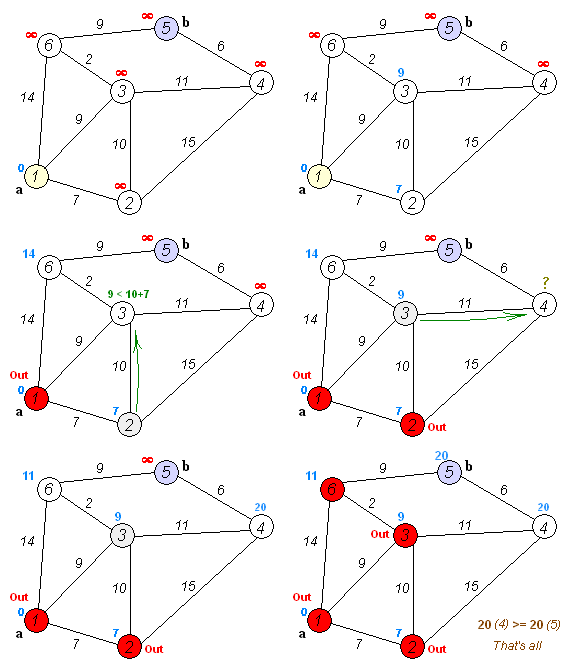
Time complexity O(ELogV) .. Time complexity can be reduced to O(E + VLogV) using Fibonacci Heap .
What if all the edges have the same weight ? you still could use dijkstra but for this special case you might consider using BFS O(V+E) because it's faster than dijkstra O(E + VLogV) . And the reason BFS would work is that in this special case there's no choice to make regarding the edge weight , they're all equal so the problem transformed to be "How many levels is the target node from the source node ?" which is achievable using BFS .
If we run Dijkstra without a target node , we'll get a SPT (shortest path tree) which root is the source node and connects all the nodes in the graph with the minimum cost starting from the source .
can we consider the resulting SPT as an MST? NO, because both SPT and MST try to achieve different goals . SPT holds the minimum cost to get to each node in the graph starting from the source .. On the other side , MST holds minimum cost to connect all the nodes together .. For example , the green tree is a SPT starting from v1 while the yellow tree is the MST of the graph .. The total cost to conect all the green nodes is 39 which is higher than the MST with a 22 total cost .. but what about the cost to go from v1 to v8 ? .. the SPT spends 21 which is lower than what MST spends (22) , so that illustrate that both try to achieve different goals hence make different compromises .. MST compromises on making the distance between two nodes the minimum to priotize making the total cost as minnimum as possible .. SPT is forced to start from a particular node , so it compromises on chosing the edges to priotize taking the shortest route to each node .
| MST | SPT |
|---|---|
 |
 |

Time complexity O(VE) which is worst than dijkstra's and they're both SSSP algrithms , so why would we choose Bellman's over Dijkstra's? because it can handle negative edges and negative cycles while dijkstra's can't .
In the graph below , there's no negative cycles but that negative edge between 1 -> 3 will reduce the distance 0 -> 2 to become 2 rather than 4 .. here dijkstra will not wait to process all the edges and once hit the target node will terminate with 4 as the answer , however there might have been some negative edges that can reduce the answer as we see in this case .
 What about negative cycles ? Dijkstra will stuck in an infinite loop because it'll always find a shorter way to reach some nodes and the heap will never be empty .. On the other side , Bellman can detect that there's a negative cycle and can get the answer as long as the target node isn't reachable by the negative cycle .
The bottom line is whenever there's a negative edge , choosing Bellman is a better idea .
In undirected graphs , the existence of only one negative edge is enough to have a negative cycle .
why we relax each edge n-1 times ? First of all that's is the maximum number of relaxation to each edge .. we could terminate after the first,sec,third.....n-1 relaxation phase through the stop-early optmization .. the number of relaxation phases needed depends on the order of processing the edges and at the worst case we'll need n-1 phase .. for example , the graph below if the order of processing the edges was from right to left , then after the first phase only the first edge with weight 11 will be relaxed and after the second phase , the new relaxed edge will be the second edge with weight 1 so that's one edge per phase rate and since the SPT of n nodes contains n-1 edges hence the n-1 phases as our maximum .

- knapsak hard
- knapsak multiple time to choose a bag allowed aka unbounded knapsak